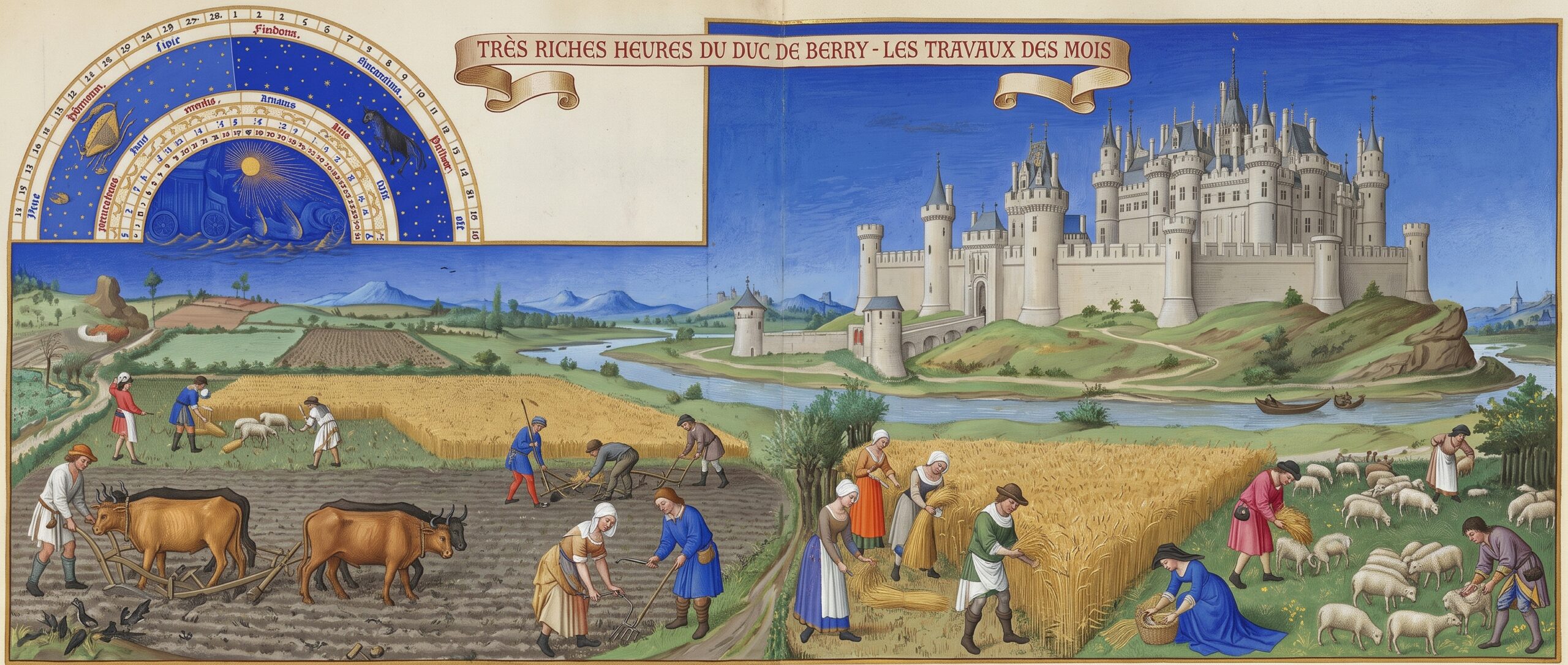
All corners of academia will soon be flooded with AI-generated research. arXiv saw the trend start a year ago and is now in full containment mode, with tightened submission controls and long moderation queues. ML conferences have exploded and find it impossible to review what they receive. Maths, CS and physics will fall first, then medicine, biology, chemistry.
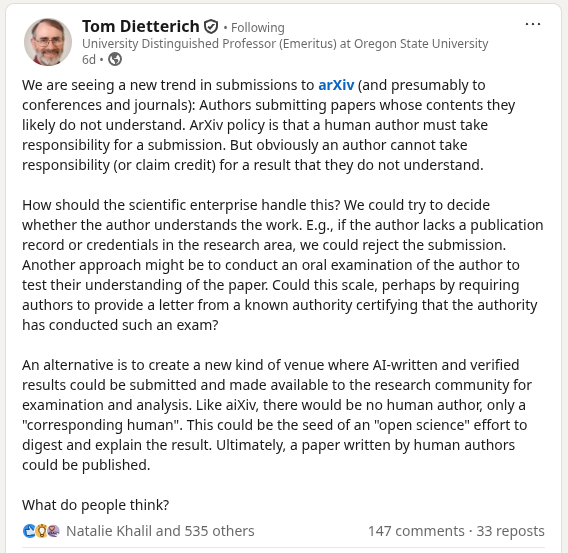
Before discussing solutions, one has to pinpoint the problem. It is not intellectual ownership: it is crystal clear that the human monopoly on intellect has ended. Screening interviews and other exercises in gatekeeping are as naive as they are futile. The problem is not scientific accuracy either — many of these papers are probably correct. Most of them are simply irrelevant, or redundant; and in any case I suspect irrelevance is a problem we will have forgotten in six months, in the same way we have basically forgotten about hallucinations.
The real problem is that any activity based on intellectual capacity is about to be hyper-inflated. Academia will fall first, the rest of the job market will follow. Academia has of course been inflating for the past 20–30 years, driven by bad career proxies that rewarded the quantity of papers rather than their quality. Perverse incentives, in economic terms: they sustained the publishing industry as we know it and blew up the bubble. AI is now pushing that trend into Weimar territory, and papers will be worth nothing.
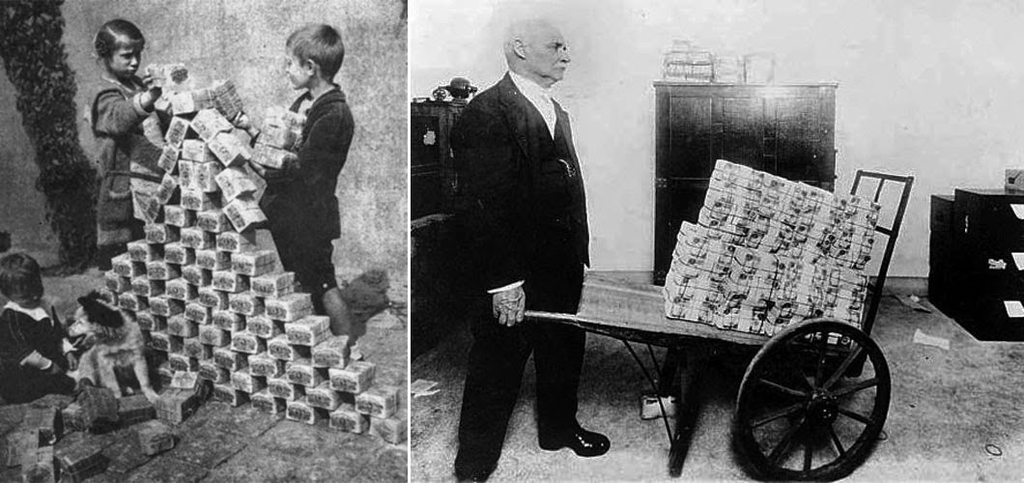
Economics tells us that when something loses value to inflation, real value moves elsewhere. If currency is worthless, you hold commodities. That is why value will transfer to the reputation of institutions: there will be so much material out there that people will pay (minimal) attention only to what comes from highly reputable sources. We already see this with the big commercial labs. Anthropic and OpenAI no longer bother putting their research in journals — DeepMind still does, for historical reasons. They publish their “preprints” and their GitHub repo, and that is it. No time for peer review and, frankly, no need for it: in the right hands and with the right support, LLMs are already decent reviewers of technical soundness.
Note what that example actually demonstrates, though. Those labs can skip review because they have already accumulated enough reputational capital to be read regardless. It is not a procedure anyone can adopt. It is a privilege that a handful of institutions happen to hold, and the rest of us are being told to admire it as if it were a method.
Reputation is a rent, not a reward
This is where the optimistic reading falls apart. Reputation does not behave like a currency you can earn; it behaves like land. It is finite, it is inherited, and its owners collect on it without having to produce anything new. An economy in which attention flows to institutional brand rather than to individual results is a rent economy, and rent economies have a well-documented set of properties: entry is closed, returns concentrate at the top, and the productive work is done by people who do not own the asset.
Once this is framed in these economic terms, consequences can be predicted. An early-career researcher at an unbranded institution loses the one mechanism that ever let them be read on merit — anonymous review of the work itself, however badly it functioned in practice. A lab outside of the golden circle producing careful, correct, genuinely novel work will be filtered out at the first pass, not because the work is worse but because nobody has the attention budget to check. Reputation becomes hereditary: you get read because you were read before.
And it will be rented out. If a big name’s imprimatur is the only thing that makes a paper legible, that imprimatur acquires a price. We already have the prototypes — gift authorship, paper mills, the last-author economy, the institutional press release as the real publication venue. Scale the attention shortage by two orders of magnitude and these stop being scandals and become the market-clearing mechanism.
Open science was, at bottom, a bet that if you removed the paywalls and the gatekeepers, the work would find its readers on its own merits. A reputation economy finally voids that bet. Free access is worthless when the binding constraint is not access but attention, and attention is allocated by brand. To be honest, we are already seeing that trend and AI will only accelerate. We will have open archives that nobody reads and closed reputational cartels that everybody does. That is a worse settlement than the one we are leaving, and it would be dishonest to present it as an equilibrium anyone should welcome.
Feudalism 2.0
The honest name for this is a return to the intellectual Middle Ages. There is a whole literature on neofeudalism: Cédric Durand’s Techno-féodalisme (2020) was the first book-length treatment, Jodi Dean’s essay “Neofeudalism: The End of Capitalism?” appeared the same year and became a book in 2025, and Yanis Varoufakis popularised the term with Technofeudalism in 2023. The shared claim is that profit is being displaced by rent, and that the owners of platforms have become a rentier class sitting above the capitalists rather than among them. Evgeny Morozov has attacked the whole framing as feudal glamour, and he may well be right that it flatters a medieval analogy that does not fit but perhaps he had not anticipated the AI contribution in all this (did anyone?).
What I can say is that academia gives the analogy an unusually clean test case, because we know what the pre-modern arrangement looked like. We had it. Before peer review, credibility ran on personal and institutional standing, and it did so within living memory. Nature made external refereeing mandatory only in 1973, under an editor who wanted to shake off the charge of being a British establishment journal. Watson and Crick’s DNA paper was never sent to external referees; an endorsement from the head of the Cavendish was enough. That is the exact mechanism I described two sections ago, running in 1953.
So the twentieth-century settlement — a paper stands or falls on procedure, not on whose lab it came from — turns out to be an anomaly perhaps sixty years long, bracketed by the same regime on either side. Which reframes what is happening now. We are not inventing a reputation economy. We are reverting to one, after a brief and historically unusual experiment in judging work by inspection.
The medieval structure was there in the university long before the journal, incidentally: the licentia docendi, the licence to teach granted by a chancellor, the guild of masters admitting its own. Authority was a franchise, held by an institution and conferred on individuals. The word we still use for an endorsement to publish is imprimatur, and it is a censor’s word.
Whether this generalises to society as a whole, I genuinely do not know, and I would be suspicious of my own eagerness to believe it. But if the pattern holds anywhere, it will hold here first, and we are as good a canary as any. The uncomfortable part is that the medieval version worked. Badly, exclusively, on behalf of a very small number of people, but it produced knowledge for centuries. Systems can be stable and unjust at the same time. That is rather the point of bringing up feudalism.
Text is cheap. Data is not.
For now, what has collapsed in value is text: the argument, the derivation, the literature review, the discussion section. Maths and theoretical CS go first because their entire output is symbol manipulation, and symbol manipulation is what these systems do. Biology comes later not because biologists are cleverer but because the rate-limiting step is physical: you cannot generate a six-week recording of a thousand Drosophilae sleeping, you have to run it. You need the animals, the incubators, the cameras, the failed pilot that taught you the arena geometry was wrong. That cost does not go to zero, and no amount of inference capacity makes it go to zero.
So the real asset in the new regime is the instrument and the dataset it produces — and, crucially, the tacit knowledge of how to make the instrument produce something trustworthy. Whoever owns the apparatus owns the only input that is still scarce. This is why, in an age of technofeudalism, open source hardware development is an act of armed resistance.
in an age of technofeudalism, open source hardware development is an act of armed resistance.
The predictable next move is that data stops being deposited, or gets deposited late, or gets deposited in forms that are technically open and practically unusable, because the group that collected it has worked out that it is now the only thing they own. We will be told this is about quality control. It will be about rent, arriving in the same shape as before, just attached to a different asset.
The counter-move is not complicated, only unfashionable: keep publishing the instrument, not just the measurement. Open hardware, open acquisition software, open raw data, and enough methodological detail that someone else can build the thing and disagree with you. A design that anyone can replicate cannot be rented out. That is the whole argument for it, and it is a better one now than it was five years ago.
General lessons and the next steps
- Cheap resistance is futile. We do not have to accept this future without struggle but any attempt at gatekeeping is lost energy and probably counterproductive. Nobody in their sane mind would want to reject a cure to a disease only because it was made solely by AI. We are considering gatekeeping through interviews and endorsement only because the material being produced is not that relevant yet, but it will soon be.
- Reshape the incentive. This is now a non-negotiable necessity. One’s intellectual contribution should be summarised in one sentence. If it cannot be summarised in one sentence, then it should not exist in the first place.
- Lower the barriers and reward creativity. The human species is entering David vs Goliath territory. The intellectual struggle with the machine will be won using Trojan horses, little sparks of cheap ingenuity. Reward those.
- Be nimble. Things move too fast. We’ll probably end up pacing the frontier, but it won’t be enough. Every aspect of our society needs to be nimble.
Riflessioni che condivido in toto. A me sembra che queste dinamiche siano originariamente da mettere in relazione al passaggio da un capitalismo produttivo (la produzione come fine) ad un capitalismo parassitario (la rendita come fine) e che l’AI rafforzi questa tendenza, almeno nei paesi cosiddetti avanzati.
Quello che, a mio avviso, facciamo fatica a distinguere sono le dinamiche di lunghissimo periodo: quanto è sostenibile questo modello? non è che chi usa la conoscenza per produrre (beni, servizi, conoscenze) alla fine si riprenderà tutto? L’evidenza empirica va in quella direzione e, così, si impone la questione di riparametrare gli strumenti di valutazione che usiamo.
[…] All corners of academia will soon be flooded with AI-generated research. arXiv saw the trend start a year ago and is now in full containment mode, with tightened submission controls and long moderation queues. ML conferences have exploded and find it impossible to review what they receive. […]
[…] super relevant and timely essay "The Weimar of knowledge" by Giorgio […]
Could you say a bit more about what you meant by “reshape the incentive”. Obviously incentives (away from quantity, towards quality for example) need to change, but what’s the connection to stating your contribution in one line?
Yeah, sorry I should have given more context. Stating your contribution in one line is an extreme example of focusing on content (hence quality) rather than quality. People hired or promoted not based on how many papers they published and in what venue but by answering a more fundamental question: “in one sentence, what is your most important contribution in the past 2 years?”.
I was wondering the same about “reshape the incentive”. Academic mathematician here. This reminds me of the Fall of the theorem economy thesis by David Bessis (https://davidbessis.substack.com/p/the-fall-of-the-theorem-economy): in my own field, the current disruption caused by generative AI will certainly result in a flood of new results which, while formally correct, they typically are hard-to-digest for humans. Whereas arguably, as most of us already know, the ultimate goal of pure mathematics is not theorem proving or conjecture solving — which was always just an easily objectifiable proxy — but rather human understanding. It is possible that AI will also excell at the digestion part of the story, and that soon it will be able to produce not just formally verified proofs but also elegant and productive theoretical cathedrals which will ultimately increase our overall understanding of maths. But still, this leaves room for a permanent place for humans (in our field!). But in order to survive the disruption of the traditional theorem economy (whereby we reward the problem-solvers much more than the enlightening explainers), we need to reorganize the maths community around better, more honest incentives.
I don’t understand mathematics enough to try and visualise how things will change. My intuition is that we will see something similar to what CERN has done to physics: lots of brilliant minds orbiting around a larger entity that in this case is not a particle accelerator but an AI brain. The incentives become more team-based and individuality is almost lost.
Pangram says this this text is 75% AI generated.
I have asked Claude to summarise the technofeudalism section. It was too long. Do you also have something useful to say?
Yes I have. You should have added, ‘A summary made by AI’ in the relevant section(s). Even though the original texts and ideas were yours and were composed by you, but in the end it was AI that have written the summary (by rearranging and recomposing your long section) in the form presented here. Writing such a summary requires significant mental efforts and deep understanding in order to re-compose your long section into a compact and consistent one, without leaving anything behind.
Other issues on your suggested “Next Steps”:
(1) “Cheap resistance is futile.” Cures by AI must be experimentally verified by humans. Would you be willing to try AI’s cure on yourself without human verification (with experiments) because AI already claims to have found the cure and AI also has verified its own claim?
(2) “Reshape the incentive.” Compact ‘one-sentence’ summary (even if it does not literally means that) of one’s work is pure lazy. It should be; What new science have ‘you’ discovered thus far in each of your paper? (exclude all your co-authors and AI contributions).
(3) “Lower the barriers and reward creativity.” Rewards should be based on (2). Anyway, do you claim the ‘creativity’, which is needed by a human to write the summary written by AI?
(4) “Be nimble.” This is again, lazy. Instead, one should always strive to achieve human-level understanding and contributions of their research, which can only be achieved with human minds. This is why human-discovered and human-verified science stand the test of time and are reliable (see (1) above).
Powerful, thoughtful essay, Giorgio. I mentioned it here and will quote it in an upcoming monthly roundup. https://doi.org/10.59350/bh7aq-21917
One possible way out of the problem you describe may already be contained in your own observation that LLMs are becoming decent reviewers of technical soundness. If AI massively increases the supply of papers, why shouldn’t it also scale peer review?
A future review system could use multiple AI reviewers to check methods, statistics, consistency, novelty and reproducibility, escalating only uncertain, disputed or especially important cases to human experts. That could preserve content-based evaluation even under extreme publication volume.
This may happen on the short term because journals have huge monetary incentives to get as many papers as possible and AI reviewing will soon be widespread. It does not solve the attention problem though, at least not for humans. Only other AI will be able to keep up to speed with the literature. Humans will forfait.
I think you are right that the attention problem remains even if AI can scale peer review. If the literature becomes flooded with technically sound but marginally relevant papers, both humans and, albeit to a much lesser extent, AI systems will have a harder filtering problem.
But that may also change which journals gain reputation. Community-governed Diamond-OA journals have no direct financial incentive to maximize the number of accepted papers, and could use AI not only to assess technical soundness but also to filter for genuine novelty, relevance and redundancy, escalating difficult cases to human editors.
If such journals consistently became better at separating signal from noise, their selectivity itself could become a source of reputation. In that sense AI might not just erode the old prestige hierarchy, but help create a new one based more on trusted curation than on institutional brand or publication volume.
[…] 임페리얼 칼리지의 조르조 질스트로(Giorgio Gilestro)가 자기 블로그에 「지식의 바이마르(The Weimar of knowledge)」라는 글을 올렸다. 그도 초파리의 수면을 연구하는 신경생물학자다. 그는 […]
[…] they needed. Removing that barrier was the right thing to do. But Giorgio Gilestro’s essay, The Weimar of Knowledge, names the opposite problem we did not foresee: a world in which scholarly-looking text could be […]