Four claims about Jason Arday spread almost everywhere in the days around his death: that he was unqualified for his job, that he was sacked for plagiarising his thesis, that he was hired to be a poster boy, and that he lied his way to the top. All four are checkable, so I checked them. What follows is what I found, and why I think the ease with which they travelled is the part that should worry us.
1. He was unqualified for his job.
Jason Arday did not have the curriculum you would expect from a University professor and a scholar. According to Wikipedia, he graduated at the age of 16 with just two GCSEs, in non-academic subjects: Physical Education (PE) and Textiles. To give some perspective, in 2024 only 3.4% of students graduated with fewer than 3 GCSEs. 83% of students graduated with 7 or more. He then went on to do a BTEC in Sports at Merton College, in South London. Anyone who is familiar with the British curriculum will recognise that this is not the trajectory of someone who is academically gifted. It’s quite literally the outcome of someone who is at the very margin of school. Someone who can hardly read and write and therefore finds a way out through disciplines that involve hand and body coordination. Arday has repeatedly explained that he was diagnosed with autism at a very young age and claimed to be almost non-verbal until the age of 11 — a claim that has been backed up by his oldest primary school friends — and to be almost illiterate until the age of 18, a claim that is absolutely compatible with his early life school CV. He was not, by any means, someone you would expect to get a PhD later on, let alone become a prolific professor in his discipline.
Someone may now read this trajectory as evidence that he was hired for all the wrong reasons: not for being academically gifted but for being black, which is also where all the public allegations originated. One may use his rather poor early-education performance as ultimate evidence that he was not qualified to become a scholar in a renowned university. But his performance as university professor was actually very far from what you would expect from someone who used to be at the margin of education. I am not a sociologist so I cannot give any reasoned qualitative measurement of Arday’s contribution but I did attempt a quantitative one, based on bibliometrics.1
Between 2015 and 2026 Arday published 39 research outputs — articles, books and book chapters — which have collected 983 citations, giving an h-index of 14. That is a little over three outputs a year, each cited around 25 times. I took these figures from OpenAlex, removed duplicate records by hand, and cross-checked the totals against Semantic Scholar. Measured against an anonymous benchmark of UK education researchers who began publishing when he did, that puts him a little above the median for number of outputs and in the top fifteen per cent for citations.2
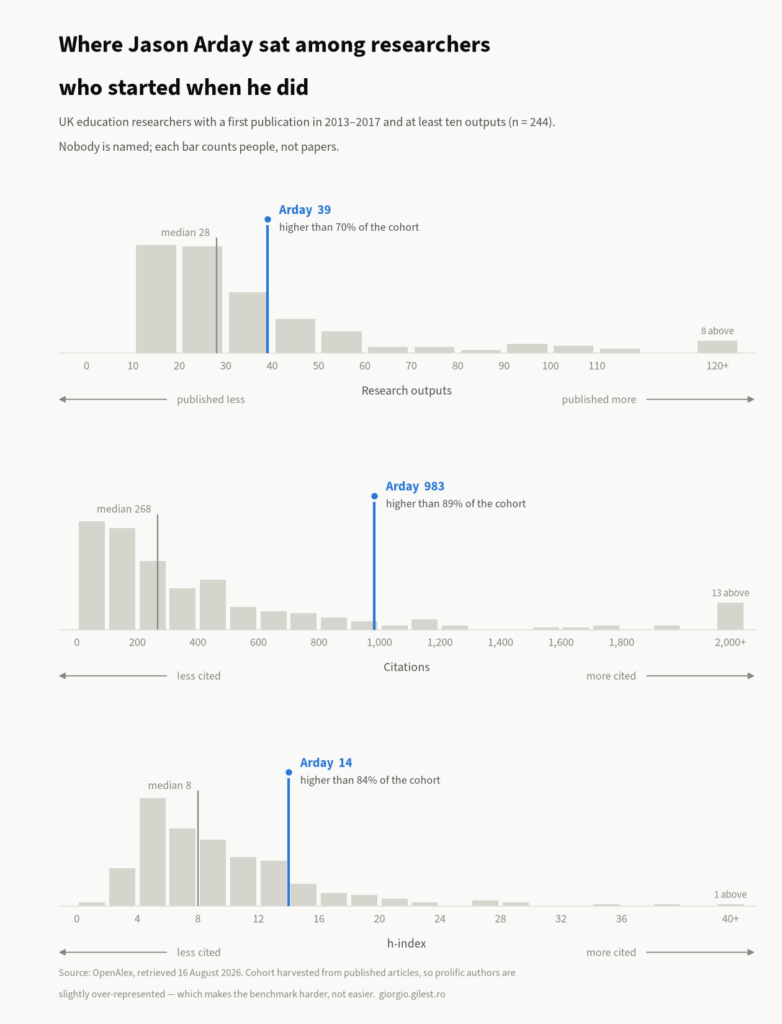
I am deliberately not ranking him against a list of named colleagues. Citation rates vary enormously between subfields, so a table like that would tell you more about who happens to work on what than about him, and it would drag people into this story who have nothing to do with it. What this comparison settle is narrower, but sufficient: this is a real and well-cited body of work, produced at a steady rate over a decade. This is not the performance of someone who has been hired for the colour of their skin. It is a perfectly decent record and, if one takes into account his life history, an exceptional one.
2. He was sacked because he plagiarised his thesis.
Before his death, Arday’s work had been scrutinised by no fewer than 188 newspaper articles in 9 days, mostly from right-leaning media whose readers are eager to confirm their EDI-hire view of society, and the decline that follows.
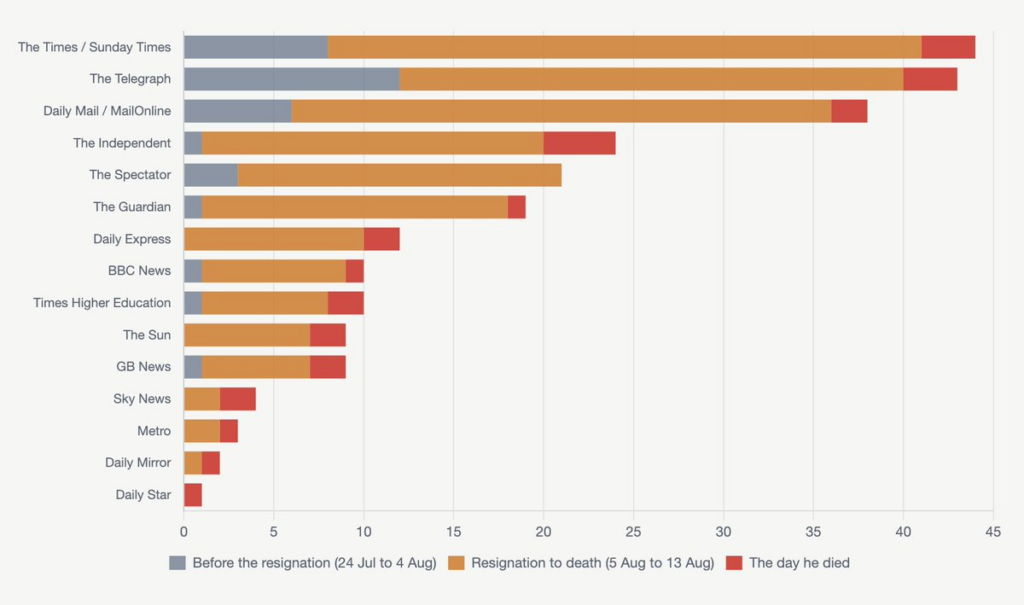
In most articles, Arday was introduced along with allegations of plagiarism, specifically with regard to his Doctoral thesis. The self-appointed “race realist” who made the story public in July 2026 — concerns had in fact been raised privately with the universities since 2023 — had shown that some of his writing was taken verbatim from the earlier thesis of another student, Dr Paula Zwozdiak-Myers, who had graduated six years earlier from Brunel University. Allegations of plagiarism had already been raised with the university that awarded the PhD (Liverpool John Moores University — LJMU) which, after an investigation, found that he had not plagiarised it, treating the overlap as within the accepted range of compliance with the academic standards of the time and assessing it against their own research misconduct policy.
I have run some plagiarism analysis myself and found the LJMU verdict to be absolutely fair and appropriate. My results are below.
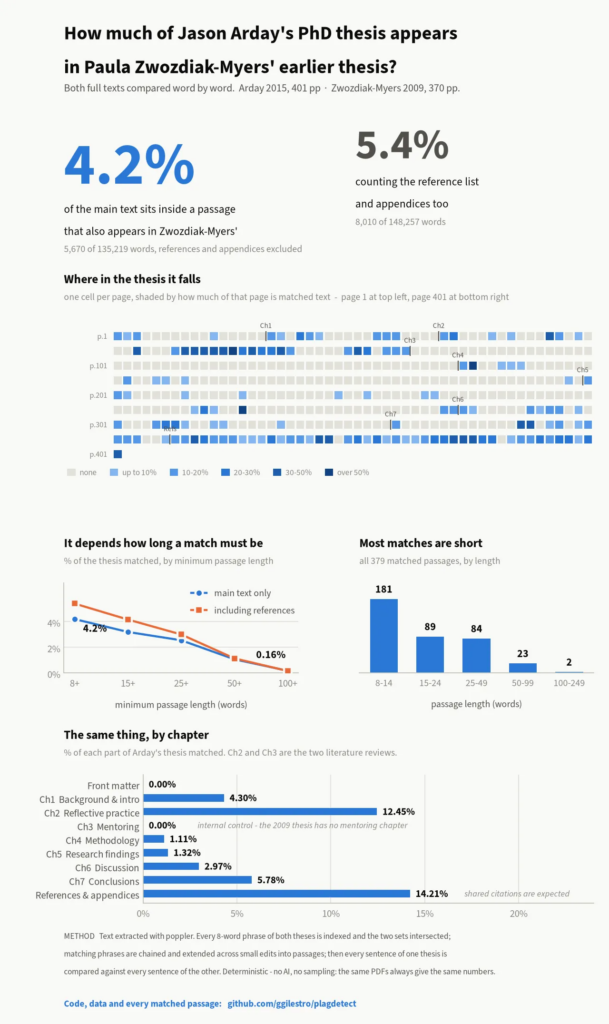
The level of “plagiarism” found in Arday’s Doctoral thesis is 4.2% — a naive reader may expect this to be zero but a colleague would certainly not. Some level of unoriginality in a doctoral thesis is quite standard. The most directly comparable work to be used as benchmark is a series by David Ison using Turnitin on samples from ProQuest Dissertations & Theses. Ison (2014) scored 368 dissertations published 2009–2013, 184 from online and 184 from brick-and-mortar institutions, with quotations, bibliographies and definitions excluded:
| Online | Traditional | |
|---|---|---|
| Mean similarity index | 13.5% (SD 7.82) | 15.2% (SD 12.82) |
| Median | 12% | 12% |
| ≤ 10% | 39% | 43% |
| 11–24% | 51% | 39% |
| 25–49% | 10% | 17% |
| ≥ 50% | ~1% | < 1% |
The two groups did not differ significantly (Mann–Whitney U = 16758.5, p = .865). The distributions are non-normal (Kolmogorov–Smirnov p < .001), so the median of 12% is the more meaningful figure. Ison (2015) compared 184 pre-1994 with 184 post-2010 dissertations and found means of 14.5% and 12.3% respectively — the internet did not increase text overlap. Ison (2012) found that among 100 dissertations, 72% contained verbatim text carrying a citation but no quotation marks, and 46% contained verbatim text with no citation.
So almost 1 in 2 doctoral theses contain a level of plagiarism higher than that found in Arday’s work. I do not want to cast a verdict on whether 4% plagiarism is a sin, but I can certainly say that, if it is, it is extremely common. If there is one lesson we should probably take from all this, it is that we have to review the academic and societal concept of plagiarism. It would be only fair to see the plagiarism score of every single Professor and PhD student at Cambridge because that value, more than many others, would highlight how Arday had been chosen as a scapegoat for a very common crime that he did not even commit.
Perhaps unveiling the rate of plagiarism in scholarly work is something that should be part of REF, ideally through open source software provided or endorsed by the Government itself.
3. He was hired just to be a poster boy.
I have read, even among colleagues, that Arday’s scholarly output was not stellar enough to justify him becoming the youngest black Professor at the University of Cambridge. Again, this is often used as an argument to imply a failure in EDI policies and, by extension, to attack or dismiss anyone who may have benefited from an EDI awakening. I have already touched on above how Arday’s bibliometric contribution was absolutely respectable among his peers. But let’s assume for a second that it was not. It is important to remember that not everyone is hired or promoted to Professor for the same merits; they are hired because they provide some value to the Department, the University, the students.
Arday’s academic work on Widening Participation in Postgraduate Study had been extremely impactful. In 2021, Research England and the Office for Students (OfS) launched an £8 million joint funding competition specifically designed to improve access and participation for Black, Asian, and minority ethnic students in postgraduate research (PGR) study. Arday’s co-authored volume with Heidi Safia Mirza (Dismantling Race in Higher Education, 2018 — note that that volume alone has accumulated 376k accesses and 286 citations) served as key policy references informing the call for proposals.
Aside from the national fund, research co-authored by Arday and his collaborators on access barriers was explicitly cited by multiple UK universities when establishing their own targeted PhD scholarships and widening-participation access routes. This kind of societal impact has incredible value for Universities because it constitutes one of the three pillars against which they are evaluated in REF. Hiring someone who brings “impact cases” is absolutely not uncommon.
There are obviously other examples each of us know and live in everyday life and some examples that the public would recognise too. Take Hannah Fry, for instance, who is Professor of the Public Understanding of Mathematics at Cambridge. She is a widely recognised communicator, winner of multiple awards and prestigious recognitions. Yet, it was probably not for her scholarly curriculum that she was recognised as Professor, and mostly for her extraordinary ability to communicate science and for the value that this brings to the University in terms of prestige and teaching.
4. He lied his way to the top.
Arday has also been accused of being a compulsive liar or, somewhat more graciously, of suffering from some mental issues. This was based on claims about his personal life that were deemed to be completely fictional. The most commonly mentioned one was to have run 30 marathons in 35 days. Arday took that challenge back in 2010, when he was 24 years old, for charity. He opened a justgiving page and collected £6,285 in donations. His achievement was celebrated by the local press.
Another claim he made that was dismissed as ridiculous was to have played semi-professional football. This was also shown to be true by one of his former team-mates.
Arday made other claims (mostly about his health) that may or may not turn out to be lies. It is not a secret that he had suffered from mental issues in the past — he talked openly about that — and so it is possible that part of what he claimed was fogged by some inability to draw a clear line between life and fantasy. In that case, he should have been protected, not mobbed. Or perhaps everything he said was true. It does not really matter in the end: playing semi-professional football, running marathons, having had a tumour: none of this gets you to become a cited scholar. And that’s what he was.
Conclusions.
I know Arday has been attacked, and still is after his death, by some despicable people. I understand that and I accept it. Those people exist; they will be hateful, scared, miserable no matter what. There is not much we can do to help them.
What I find unfortunate — and most importantly what we can fix — is that those lies spread too easily even among those who would normally be more considerate, more empathetic; people who would normally not take a statement at face value without a little check; people who would normally not automatically buy accusations of this kind. To those people I say: this story seems to have two paths and you somehow chose one over the other, instinctively. Ask yourself why.
- A caveat, since I am a biologist writing about a sociologist of education: bibliometrics travel badly between disciplines. In education and the social sciences a great deal of what matters appears as books, chapters, reports and policy documents, cited slowly and often outside the journals that indexing services count at all. Even in STEM, where these metrics were invented, they measure attention rather than quality — and in fields like this one they measure rather less than that. I have used them here only because they were something I could actually check, not because they settle anything. ↩︎
- The reference figures come from an anonymous benchmark cohort I built from OpenAlex: authors of research articles classified in the Education subfield, carrying a UK institutional affiliation, with at least ten indexed outputs, and whose first indexed publication falls between 2013 and 2017 — matching Arday’s own start in 2015, so that the comparison is with people at the same career stage rather than with senior professors or with doctoral students. Cohort size n = 244. Median 28 outputs and 268 citations; upper quartile 42 outputs and 539 citations. Arday sits at roughly the 70th percentile for outputs (95% CI 65-76) and the 89th for citations (85-93). No individual is named and only the distribution is reported. One bias is worth stating: candidates were harvested from published articles, so prolific authors are more likely to enter the pool, which makes the benchmark harder than the true population median and therefore understates rather than inflates his position. ↩︎
Thank you for this article!
Dear Giorgio,
Thanks for this brave and precise article. I perfectly agree, the accusations were specious and sadly underwent a mediatico pattern, feeded by different stakholders. Noone proved plagiarism, as you pointed out. The academic research requires a list of significant (accepted) sources for the quotes, thus we find similar paragraphs in every essey/paper of same issues.
As a sociologist and methodologist of social sciences (MRes), I can state that some of his papers I could read now were well organized and significant, proving precise definitions – which are the core of social sciences since most of the factors involved are social costructs. Some papers display other good authors and this proves the authenticity and academic acceptance. The issues he worked on were extremely important and complex. Best regards
i am just asking you a simple question. Numbers tell one story: 4% of plagiarism. Did you actually check the passages where that happens? There are VERBATIM paragraphs that have been lifted from someone else’s work. A plagiarism checker also checks for near-similarity, but if you do your homework properly, you’ll see that it’s not just a negligible 4%. It is HOW that was done that was inexcusable. And I say this having sat in countless plagiarism cases in my own university. It is rarely HOW MUCH but HOW
Yes, that’s what plagiarism is. You would not get even that 4% without verbatim passages. I have done my work properly, the software used is open sourced and you can see a list of verbatim passages here. One thing perhaps I should have placed more emphasis on: these allegations were officially investigated by the University, through a standard procedure that normally involves several people, including third-party academics from other faculties, and goes through many weeks of scrutiny that moves beyond the quantity and deepens in the quality. At the end of that procedure, those accusations were dismissed as being considered within normality. Two things here: firstly, a procedure that lasts weeks and involve many professional should not be easily dismissed on the basis of a very cursory look by a random guy on the internet: the levels of scrutiny simply cannot compare. Secondly, one may argue universities are often complicit with this kind of crime and who knows perhaps they are, but if they were, then the whole argument of personal responsibility should follow suit, and this becomes a game of “Così fan tutte”.
Modern softwares investigate verbatim and non verbatim plagiarism
Thanks for this work. I hope journalists get to read it. I was just reading The New York Times about Prof Arday and it seems to me that there is no deep investigation whatsoever in this case. I was particularly surprised by the interview with this so-called investigative journalist mara.hvistendahl@nytimes.com whom should read this blog post.
Same reflection here this morning. I have been looking for something that could give me data about what level and kind of plagiarism Arday was supposed to have committed- and this is the first analysis I have found. I am a journalist and am appalled by the lack of data in this case: my reasoning was, Arday possibly was a plagiarist and a conman, but show me the proofs.